
When selecting outdoor furniture for your living space or commercial project, you might be browsing for a “4 person Outdoor Dining Set with umbrella” or searching for the “Best outdoor dining sets for 4”. While style and price are important, a deeper consideration is increasingly coming into focus: carbon footprint. This article provides an in-depth calculation and comparison of the carbon footprint of locally made furniture versus imported goods, helping you make a more environmentally friendly and economical choice.
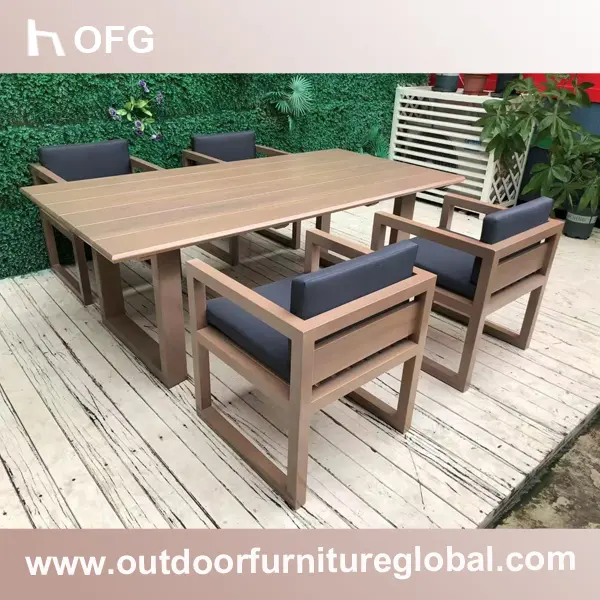
The Composition of a Carbon Footprint: From Raw Materials to Your Garden
The carbon footprint of a piece of outdoor furniture spans its entire lifecycle, including:
-1. Raw Material Extraction & Production: Manufacturing aluminum, steel (common in Metal park benches and Metal Outdoor Dining Sets for 8), wood (for Wooden Park benches), and plastics (like the recycled plastic used in polywood dining set) consumes vast amounts of energy.
-2. Manufacturing Process: The energy mix of factories—whether from a local outdoor furniture manufacturer in china or an overseas supplier—varies greatly and directly impacts carbon emissions.
-3. Transportation: This is where the carbon footprint difference between local and imported products is most significant. A piece of global outdoor furniture produced by an “outdoor furniture manufacturer in china” must travel by container ship across oceans and then by truck, potentially generating dozens or even hundreds of times more transport emissions than a local product.
-4. Lifespan & End-of-Life: Durability is crucial. what outdoor furniture lasts longest? The answer is products that don’t need frequent replacement. A piece of Heavy Duty commercial outdoor furniture might have a higher initial carbon footprint, but its long life results in a much lower annual footprint than a cheap product that needs yearly replacement.
In-Depth Calculation: Locally Made vs. Imported
Let’s analyze a typical “Outdoor Dining Set for 4 Round Table” as a case study.
· Scenario A: Locally Made
· Raw Materials: Aluminum sourced locally or wood from sustainably managed forests.
· Manufacturing: Produced in a factory within 500 km, potentially using some renewable energy.
· Transport: Delivered via truck.
· Estimated Total Carbon Footprint: Low. Emissions from transport are minimized.
· Scenario B: Imported
· Raw Materials: Possibly sourced globally, with their own transport emissions.
· Manufacturing: Produced in a factory of an “outdoor furniture manufacturer in china,” where the grid may rely heavily on coal.
· Transport: Shipped via container vessel from East Asia (high emissions), then distributed by rail and truck.
· Estimated Total Carbon Footprint: Very High. Ocean freight alone can exceed the total emissions of Scenario A.
This calculation clearly shows that choosing a locally made “outdoor table and chairs” holds an overwhelming environmental advantage. This is especially important for businesses sourcing “Restaurant furniture” or “commercial outdoor furniture,” as larger order volumes magnify the carbon footprint difference.
Material Selection: Extending Lifespan, Reducing Emissions
When comparing “wicker vs aluminum patio furniture” or “wicker vs metal outdoor furniture”, material durability and composition are key.
· what is resin wicker made of? It’s typically a synthetic fiber made from polyethylene (PE) or PVC. In an outdoor furniture material comparison of “pe wicker vs resin wicker”, high-quality PE wicker is often more UV-resistant and durable.
· Aluminum Furniture is lightweight, corrosion-resistant, and 100% recyclable, making it an excellent eco-choice.
· polywood dining set, made from recycled plastic, is highly durable and low-maintenance.
Choosing what outdoor furniture lasts longest means fewer replacements, thereby reducing your long-term overall carbon footprint. This is why Heavy-duty park Bench and In ground Park Bench units are so popular in public spaces—they are built to last.
Informed Buying Tips for Consumers
-1. Prioritize Local & Regional Brands: When searching for “Outdoor Dining sets for 4 sale” or the “Best outdoor dining sets for 4”, prioritize local Park Bench company or domestic manufacturers.
-2. Value Durability Over Low Price: Invest in a high-quality “Heavy Duty commercial outdoor furniture” set or a Small Outdoor Dining Set for 4. Its lifespan will outlast multiple cheap imports. Avoid the temptation of low-priced “Amazon Park Benches” or “Home depot Park Bench” which may lack durability.
-3. Consider the Second-Hand Market: For projects on a budget, “Used commercial park benches for sale” is an excellent option, giving products a second life with an almost zero carbon footprint.
-4. Ask About the Supply Chain: Inquire about the origin and manufacturing standards with “global garden furniture” wholesale outdoor furniture suppliers or “wholesale outdoor dining sets” vendors.
Conclusion
Beyond the debate of “wicker vs aluminum patio furniture” lies a more critical choice: responsibility for the planet. Through in-depth carbon footprint calculation, we can clearly see that supporting locally made “garden table and chairs set” and “patio dining sets” is not just a patriotic act but a profound environmental one. Whether you are selecting the “Best outdoor dining sets for 4” for your backyard or procuring “wholesale park benches” for a municipal project, making an informed choice allows you to enjoy a beautiful, durable outdoor space while lightening the load on our shared Earth.